
How to Read the Sunday Gospel

Rev. Noah Carter • July 17, 2022

I wanted to share a practice that I mentioned at two of the Masses that I preached two weeks ago. As we traverse with our Lord and his disciples during this Ordinary Time in Year C, it can help us to not read just the Sunday reading, but the preceding and next Sunday Gospel from our Bible. We are working our way through the Gospel of Luke. However, there are times in which a handful of verses are left out. It’s one thing to read the Sunday Gospel and try to understand what it means on its own, but it’s a beautiful thing to read it in light of its grander context. This also means that we will read each Sunday Gospel three times over the period of three weeks, unpacking what we’ve heard before, preparing ourselves for what is coming on Sunday, and anticipating the next Sunday when we will gather again and sit at the Teacher’s feet.


Today’s Gospel is the famous passage about Jesus visiting the home of Martha and Mary. Martha is the one carrying out all the domestic work to welcome their guest and Mary is soaking in the teachings of Jesus and visiting with him in conversation. When Martha demands Mary’s help and asks Our Lord to intervene, he gently rebukes her to make the point that in his presence, she must quiet herself. “Mary has chosen the better part and it will not be taken from her.” Obviously, Our Lord wants his disciples to quiet their hearts in his presence, converse with him alone, and forget the material concerns of life. While this can mean different things for different walks of life, in a parish community, the Lord is inviting us to visit him periodically in the Blessed Sacrament for quiet prayer in the church and to forget the cares of the world. There in his Sacred Presence, he desires to give a peace that only he can give.


Moreover, when read in the context of the previous Sunday’s reading and next Sunday’s reading, we see a long narrative of how Christ is forming a “school of discipleship.” Last Sunday was the Parable of the Good Samaritan. In that parable, the Samaritan is Christ who responds to our fallen human nature which has been left beaten and bruised on the side of the road, an image of original sin. The Samaritan/Christ, responds through the sacraments of Initiation (water, wine, and oil) in order to place the man in the inn (the Church) run by the innkeeper (St. Peter and the popes), who receives two coins for his wellbeing (Scripture and Tradition). Next week, the Lord will teach his disciples how to pray (the Our Father), and speak to them of how they are to treat fairly the good and bad alike, just as God treats all alike. In this context, our Lord lays out the beauty of His response to our woundedness in the sacraments, teaches his disciples through Martha and Mary that after rescued they must spend time contemplating God’s Word, and then originating in a spirit of prayer, go out and equally bring the good and the bad to the same communion with the Father that each one of us has found.

Pastor's Ponderings
By Noah Carter April 18, 2026
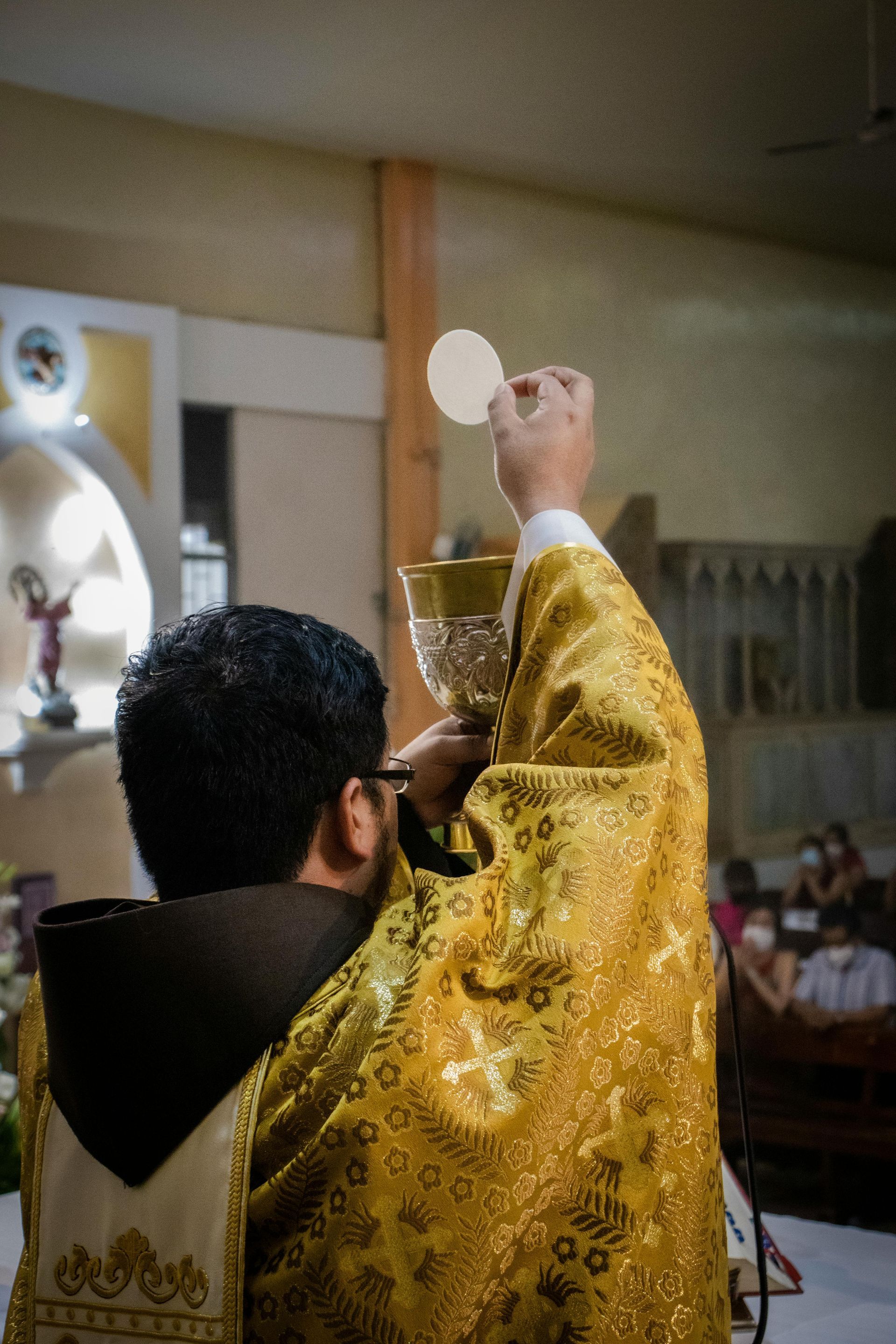
We reflect this weekend on Christ's appearance to two of his disciples as they journey from Jerusalem to the town of Emmaus. They do not recognize him until he celebrates the Eucharist in their home. And then he disappears from their midst. One of the most iconic Eucharistic hymns of the Roman Catholic Church is St. Thomas Aquinas' "Adoro Te Devote." I have given a translation below from the famous English poet Gerard Manley Hopkins, hoping that it can serve as a subject for your personal prayer.  Adoro Te Devote by Saint Thomas Aquinas (Translated by Gerard Manley Hopkins) Godhead here in hiding, whom I do adore, Masked by these bare shadows, shape and nothing more, See, Lord, at Thy service low lies here a heart Lost, all lost in wonder at the God thou art. Seeing, touching, tasting are in thee deceived: How says trusty hearing? that shall be believed; What God’s Son has told me, take for truth I do; Truth Himself speaks truly or there’s nothing true. On the cross Thy godhead made no sign to men, Here Thy very manhood steals from human ken: Both are my confession, both are my belief, And I pray the prayer of the dying thief. I am not like Thomas, wounds I cannot see, But can plainly call thee Lord and God as he; Let me to a deeper faith daily nearer move, Daily make me harder hope and dearer love. O thou our reminder of Christ crucified, Living Bread, the life of us for whom he died, Lend this life to me then: feed and feast my mind, There be thou the sweetness man was meant to find. Bring the tender tale true of the Pelican; Bathe me, Jesu Lord, in what Thy bosom ran Blood whereof a single drop has power to win All the world forgiveness of its world of sin. Jesu, whom I look at shrouded here below, I beseech thee send me what I thirst for so, Some day to gaze on thee face to face in light And be blest for ever with Thy glory’s sight. Amen.
By Rev. Noah Carter June 1, 2024
This is part three of a three-part series on Episcopal consecration.
By Rev. Noah Carter May 26, 2024
This is part two of a three-part series on Episcopal consecration.
By Rev. Noah Carter May 19, 2024
This is part one of a three-part series on Episcopal consecration.
By Rev. Noah Carter February 18, 2024
Nuestra triple observancia de la Cuaresma corresponde al triple mandato de Cristo de responder a la Buena Nueva.
By Rev. Noah Carter January 28, 2024
Como en la sinagoga de Capernaum, ¿está Satanás entre nuestra congregación?
By Rev. Noah Carter December 19, 2023
Headlines misrepresent a recent document issued by Vatican
By Rev. Noah Carter December 11, 2023
Vatican offers updated guidelines regarding the handling of cremated remains
By Rev. Noah Carter September 3, 2023
A particularly good novel that I finished earlier in the year is A Man Called Ove , by Swedish author Fredrik Backman. First released in 2012 in Swedish, it hit the market in English just a year later and was on the NYT Best Seller list for over 10 months. Ove is a 59-year-old man who is wrestling with sadness and loneliness after having lost his wife Sonja. His neighbors and the townsfolk see him as a crotchety old man with a disdain for others. He has difficulty dealing with others as he is all caught up in his fond memories of his wife and recollections of their life together. Throughout the tale, I enjoyed the author’s keen insights into the human psyche, especially how sadness and loss can cripple one’s ability to form new relationships and darken one’s view on life around them. As the story unfolds, Ove is confronted with new situations, neighbors, and experiences that allow him to come out of his isolation and find meaning in community as a sort-of new family. It is truly a heartwarming read. If I read it again, it would be during winter by a fire with a cup of tea; that now seems the best setting. Warning: the book contains material revolving around depression and suicidal ideation. I came across an interesting read in May — interesting because I found the book per chance at a book giveaway, did not have much hope for it, and ended up content upon finishing it. I am usually disappointed in modern retellings of the lives of the saints, especially when so many modern non-Catholic authors try to debunk the supernatural or discredit the Catholic Church in the way they re-tell the story. I was quite happy with Kathryn Harrison’s Joan of Arc: A Life Transfigured . Born in the 15 th Century, Joan of Arc led her fellow Frenchmen into battle against England. She claims that angelic voices led her to do so. Captured during the siege of Compiègne, she was put on trial by the English ecclesiastical authorities. After a trial verdict of guilty that was posthumously overturned, she was burned at the stake at age 19 for blasphemy, heresy, and following demonic visions. Much legend surrounds her life, especially fantastical accounts of her prowess in battle. Harrison attempts (successfully, in my opinion) to entertainingly tell Joan’s story devoid of unhistorical details that lack evidence. Her sources include Scripture, historical accounts, and the trial records kept during Joan’s prosecution. While I do not agree with all of Harrison’s portrayals and conclusions, the book as a whole is a very unique look at the life of the Maiden of Orléans.
By Rev. Noah Carter August 27, 2023
In preparation for a faculty in-service at Bishop McGuinness Catholic High School, I reread this summer C.S. Lewis’ The Great Divorce . The title pays homage to William Blake’s poem The Marriage of Heaven and Hell. In Lewis’ short story (less than 150 pages), we follow the narrator on a bus ride to a fantastical place along with many grumpy passengers. When they disembark, they are revealed to be ghosts. There are a number of descriptions that seek to pin down the precise meaning of Lewis’ allegory. I have always described it as souls from hell are given one day at the doors of paradise, but must confront someone they knew in life who is now in heaven. The dialogue is fast-paced and makes the reader reflect about their own actions, responses, and priority of loves in their own life, but weighed against the love they have for heaven. In terms of southern, Catholic authors, Flannery O’Connor and Walker Percy are two of my favorites. Walker Percy (1916-1990) lived most of his life in Louisiana and was an Oblate of St. Benedict. He was trained as a physician but, after contracting tuberculosis, dedicated his life to philosophy and writing. This summer, I read Percy’s last novel The Thanatos Syndrome , published in 1987. It is a sequel to Love in the Ruins . It is set in the not-too-distant future in a town where residents are experiencing “off” behaviors. It follows a psychiatrist and lapsed Catholic who returns to his hometown and begins observing strange behaviors in the residents, including his wife with whom he is no longer in love. He feels compelled with the assistance of his cousin to figure out what the root cause is. One element that I enjoy in Percy’s novels is that there is always a fallen priest character that is secondary to the main plot. In The Thanatos Syndrome , the local parish priest has been replaced because he has given up the ministry and run off to live in a wildfire watch tower in a nearby National Forest. The interchanges between the psychiatrist and priest are comical, enlightening, and quite on the nose about fallen human nature. Altogether, the novel moves briskly in its plot as it introduces a number of poignant themes: the fallen hero; a world gone crazy; science’s role in the devaluing of human dignity; and the inability of society to function without a shared language and shared moral values. As a caveat, let me be clear, this is not a novel for young ones as there are some adult themes present.